






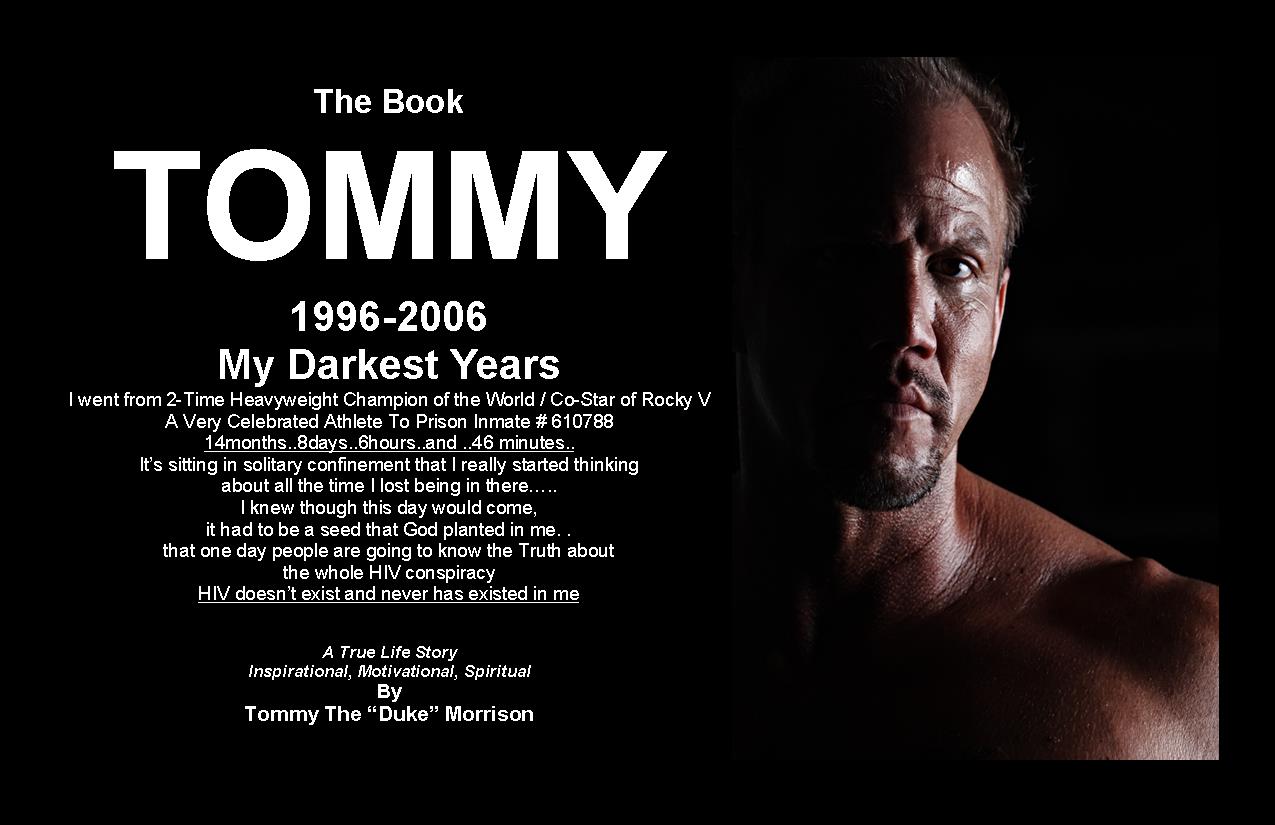
Boxing Book Review World Exclusive: Tommy The Duke Morrison 1996-2006 My Darkest Years
Editorial By Robert Brizel, Head RCM Boxing Correspondent
With encouragement from Trisha ‘The Duchess’ Morrison, Real Combat Media presents an international exclusive, the first book review in a three part series of the writings of the late former world heavyweight champion Tommy ‘The Duke’ Morrison, completed before his untimely passing last year. In doing so, this boxing writer is lifting the top ‘on the mystery’ behind the mysterious three books written by Tommy Morrison, published posthumously, with sales to benefit his children. Tommy’s three books can be purchased online at http://www.tommymorrison.com
Tommy 1996-2006 My Darkest Years, second in the three part series by Morrison, is in booklet form, and as such comes across as more of a nonfiction novelette, the first time I have used this terminology. While Morrison’s autobiographical novelette in the series does not dawn deeply on the factual details of the decade when he was ‘missing’ from public view, it does give a glimpse into the interior of Morrison’s soul. Morrison, in essence, looks inside his subconscious mirror and paints a self-portrait of his inner feelings as relates to a particular time period in his life.
One particular haunting anecdotal in the novelette is Morrison’s recollection of his prison number 610788 from the time of his incarceration from 1999 to 2001. One particularly bright anecdotal is Morrison’s fond memory of the five friends who never changed and stayed by him during both the good and the bad times.
Self-control, and the lack of it, are major themes in Morrison’s life as he recalls the time period of ten years in his life, when his entire life spiraled out of control. The concept of Morrison’s elements of wisdom, from self-denial on some issues, and self-realization on other issues, begins almost as blunt as the late chess champion Bobby Fischer’s long forgotten booklet ‘I Was Tortured in the Pasadena Jailhouse’.
Morrison recalls his start in boxing in his native Jay, Oklahoma. While driving around Jay one night, Morrison simply realized boxing was his destiny and goal in life, and was what he wanted. Even though, Morrison reminisces, he did not have the passion for it. His heart, mind and body were in harmony with a path determined by a feeling from God. This flashback, Morrison subsequently reflects, forced him to dawn on why God would shine a light for him to follow on the boxing path, then take it all away.
In considering on his fleeting taste of fame, and then losing him, Morrison searches for the meaning of his life, and his higher purpose for being here. Morrison does not mention when he appeared on the Maury Povich Show in 1996, he had considered a new career of educating young people starting off on the road of life how to make educated choices. Although Morrison got lost within himself into the pit falls of drugs and problems with the law during his dark years, it appears he lost his early realization of educating youth onto the correct path before his fall into an abyss, from which his writings and final marriage eventually helped him climb out of the depths of hell.
Morrison makes a profound reference to the infamous Elvis Presley’s Memphis Mafia press conference where fired bodyguard Dave Hebler states about Elvis, “Protect a man? How do you protect a man from himself?” Or as Sonny West, another Elvis fired bodyguard also profoundly put, “The world. He (Elvis) had it in the palm of his hand and he blew it.” The references came several weeks before Elvis death in the promotional press conference for the book ‘Elvis Presley-What Happened?’ written by three of Elvis’ former bodyguards and released in the weeks before Elvis died, which might have contributed to his untimely death. The original quote noted by Morrison made by Hebler can be found on YouTube here at https://www.youtube.com/watch?v=FPG70wbbj1M
Tommy was keenly aware of the eight years he built himself up were paralleled by the ten year period in which he fell down. Morrison begins the downward slide by referencing the fight he took with Marcus Rhode in Japan in November of 1996, a first round stoppage which last 138 seconds, for which Morrison reveals he did not get paid. The bout was intended to be a benefit for the Tommy Morrison Foundation. The intention of the foundation, and what happened to it, appears to have been lost around the same time.
Morrison remembered his rise in his native Jay, Oklahoma, began with a sign with his name which was up between 1993 and 1996, and was torn down when Morrison held the press conference in 1996 in which he announced his retirement from boxing. Retreating to his ranch in privacy, Morrison dealt with immediate setbacks which soon evolved into emotional cruelty: he did not have a job; he did not have a gym he could work out at where people would accept him; the onset of his loneliness and depression; and the loss of many friendships, with nobody significant to seriously talk to who could truly understand him.
Morrison does not mention health insurance. If Morrison had such a plan covering himself and his family at that time, he might have south professional help for his inner demons. Sadly, Morrison, like so many other celebrities past and present, allowed the warning signs to go unheeded in his darkest hours. Morrison remembered more so his love of guns and cars. He apparently had forgotten love of self as he sunk into his declining state self-despair and low self-esteem during his difficult years, staying up for days on drugs, not wanting to live.
It appears prison time helped force Morrison to begin to put himself back together during the dark decade of his life. His 14 months of confinement included 120 days of solitary confinement, and segregation in the prison psych ward. Morrison notes he was forced to take the drug AZT during this period. Most people who took this drug eventually died from complications due to taking it. In his darkest hours of confinement, it appears Morrison experienced a spiritual revelation from the Holy Scriptures which were sent to him, and unto the lord he lifted his soul. Yet, Morrison continues to portray an ongoing loneliness, as if he knew his remaining days were numbered, and he was running out of time to put his thoughts to paper for posterity and boxing historians.
Morrison appears keenly aware of details of his life as his health was failing, noting his mother preached faith, while his sister and father seemed to have buried him. Much like the late Michael Landon, as time ran out, and the world around Morrison imploded, Tommy became keenly aware of all of the details around him, people, places and things.
Perhaps the most eye opening section of Morrison’s novelette is his late realization of the importance of having the correct trainer, manager and promoter, the lack of which adversely affected his career at different points. Morrison mentioned the friends who alerted him to the fact he was getting swindled out of his purse money. Morrison remembered his cars, his boat, and a number of important personal belongings, all of which were stolen. Worse, Morrison remembers the people who borrowed money from him and never paid it back nor ever intended to, who later disappeared from his life forever when the chips were down. Such is the story of people who loan out money.
Morrison recognized family-namely his wives, and three children-should have had top priority at all points in his life. Sadly, it was too late for Tommy to salvage his relationships and loss of time spent with family, which the reader can decipher. Though Morrison doesn’t state it directly, he must have felt a great deal of pain over separation from his children once he matured from within. “My own family started pulling away from me, and then it was just me, and then I was just alone.” Reflecting on his own boxing comeback in 2006, Morrison explained “I’m one of those guys, once I start something, I’ve gotta finish it.” The three novelettes, which Morrison embarked on as a writing project near the end of his life, were a reminder to him of the same level of discipline and commitment he acquired during his best boxing days.
Morrison’s reflections on his acting, and his co-starring role with Sylvester Stallone in Rocky V, seem to clamor for a second life as an actor. Tommy had the talent and potential to realize a serious acting career-but he never had the chance due to the circumstances of his life which followed, which the reader understands. Morrison’s dream of teaching his children and perhaps other prospects to box is a reference to a later stage in life, where the boxer passes his craft onto the next generation. Tommy unfortunately missed this stage completely.
Tommy Morrison Rocky Tribute Clip https://www.youtube.com/watch?v=zqL_CkRosAE
God, Morrison reasoned, made him realize all the things he should have been doing. Realizing he still had much to live for, but pressed for time to put his thoughts down on paper, Morrison states “I could never wish it on any of you to go through what I went through.” Still, Morrison notes, he might have overdosed had God not intervened. “All those days in solitary confinement made me reconnect with Him.” Morrison’s incarceration also forced him to clean up his act when he was there. “I missed the competing-the fighting-because that was what I was put here to do.” Morrison’s competitive spirit would bring him back into the arena to fight once again, years after he was forgotten.
This review does not dawn on any physical illnesses Morrison might have had during this period, because it is evident Morrison’s mind and health was fine during the writing of his memoirs. Morrison’s obsession with the medical documentary ‘House of Numbers’ is not mentioned by Tommy in his numerous medical references in this partial autobiography of Tommy’s philosophies and belief system based on his experiences during the decade he disappeared from public view. Perhaps this is so because even though his novelette has numerous medical references which clearly are on his mind as he interprets them, the ‘House of Numbers’ movie did not come out till 2009, which is a different time period in Tommy’s life.
In terms of substance abuse, in his darkest years, the reader presumes Tommy had alcohol and substance abuse problems, as Tommy refers to issues with them during his dark period. It isn’t necessary for Morrison to go into detail in terms of what, how much and when. What takes precedence is Morrison’s ability to look back and recognize his mistakes.
Tommy Morrison Career Tribute Clip https://www.youtube.com/watch?v=-EMWZatnaPE
Tommy 1996-2006 My Darkest Years is not a work of intellectual achievement. Rather, Morrison opens up a page inside his soul, for the boxing fan who would remember him and understand him after he was gone, to analyze Morrison’s self-understandings of the darkest years of his life. Where he was, everything he did and why, and how he survived the full ten years of personal hell he endured to return to the ring is not elaborated on. For that, Morrison leaves the reader in even greater mystery. Morrison tells whoever is reading his book, who is in a difficult position in life such as he was, to just know there is a future, and to have faith. Some, like Robin Williams, never got the message.


 English