






Inside the Fight Over the Ali Act: What Zuffa Wants, What Oscar De La Hoya Wants, and What Actually Changes for Boxing
By Real Combat Media Boxing Editorial Staff
Washington, D.C., (August 9th, 2026)–Boxing’s federal rulebook has not been rewritten since the year 2000, and it may not stay that way much longer. A bipartisan bill called the Muhammad Ali American Boxing Revival Act, formally introduced in the Senate roughly a week ago by Senators Ted Cruz and Jacky Rosen after clearing the House by voice vote in March, is now the single biggest fight in the sport, and it isn’t happening in a ring. On one side sits TKO Group Holdings, the parent company of the UFC and WWE, which co-founded Zuffa Boxing in 2025 and wants Congress to open a legal lane for it to run boxing the way the UFC runs MMA. On the other side sits a coalition that includes Golden Boy’s Oscar De La Hoya, Top Rank’s Bob Arum, Matchroom’s Eddie Hearn, Evander Holyfield, and, most symbolically, Muhammad Ali’s own grandson, Nico Ali Walsh, all warning that the bill strips the very law that bears the Ali name.
This is RCM’s attempt to lay out, as plainly as the subject allows, what the original Ali Act does, what Zuffa is actually asking for, what the bill would change in practice, what both sides say in their own words, and where things realistically stand heading into the fall.
What the Original Ali Act Actually Does
The Muhammad Ali Boxing Reform Act of 2000 built on the earlier Professional Boxing Safety Act of 1996. Together, they form the only federal sports regulation of its kind in the United States. The core idea is simple: promoters and sanctioning bodies have to stay separated, promoters have to disclose the money involved in a fight, and managers can’t also serve as promoters, because doing so creates a direct conflict of interest between the person negotiating a fighter’s pay and the person collecting the profit. It was written specifically to stop fighters from getting boxed into exploitative, one-sided deals, and it has governed the sport for a quarter century largely untouched. Notably, MMA has never been covered by it. The late Senator John McCain tried to extend the Ali Act to MMA back in 2007; the UFC fought the effort, and it died.
What Zuffa and TKO Want
TKO Group Holdings, which owns the UFC and WWE and co-founded Zuffa Boxing with Saudi Arabia’s Sela, has been the driving financial and political force behind the Revival Act from the start. Zuffa staged its first card in January 2026 and has said it plans a full slate of events, a roster of roughly 200 fighters, and its own rankings and titles going forward, without working through the existing sanctioning bodies. The bill is the legal vehicle that would let it do that as a “Unified Boxing Organization,” or UBO, an entity allowed to act as promoter, matchmaker, and title-granting body all at once, something the current Ali Act’s conflict-of-interest rules were written to prevent.
Dana White has repeatedly framed it as additive rather than destructive. “Not one word is going to be changed. Not one thing,” White said on the “3 Knockdown Rule” podcast, describing the bill as “just an add-on to the Muhammad Ali Act.” TKO board member and WWE president Nick Khan, who has served as the company’s lead witness in Congress, has made the same case under oath, testifying that UBOs would offer fighters a genuine alternative system built around $200 per round minimum pay, $50,000 in injury insurance starting in training camp, standardized medical protocols including annual brain imaging, and contract structures fighters could choose or decline. Following the California State Athletic Commission’s unanimous 6-0 vote backing the bill in October 2025, Khan said on Zuffa’s behalf that the proposal offers fighters “more choice and opportunities, better pay, greater health and safety protections, and more events in which to compete.” Both White and Khan issued fresh statements this week supporting the newly introduced Senate version.
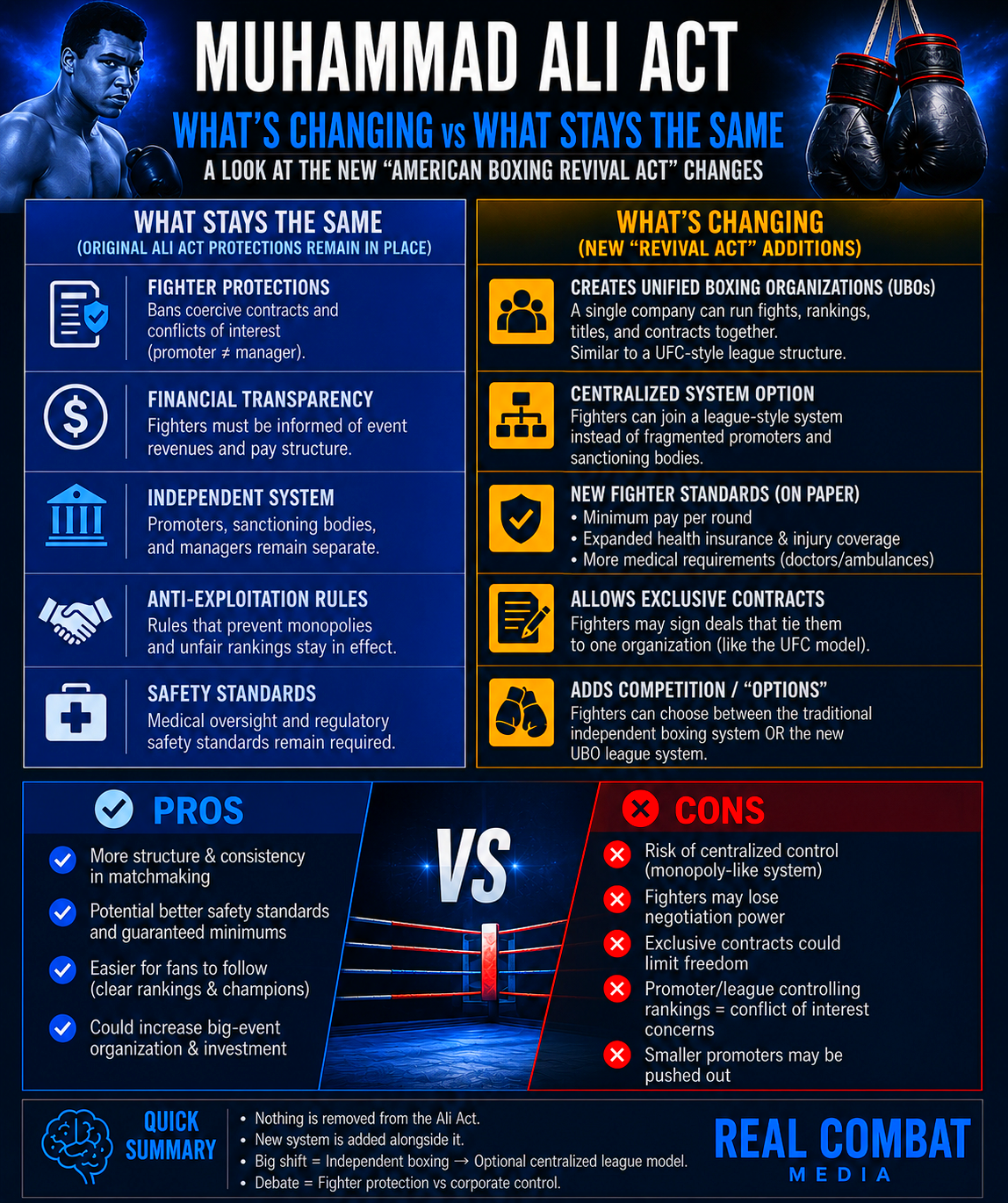
What the Bill Would Actually Change
Stripped of the rhetoric on both sides, here is what’s concretely in play:
- Unified Boxing Organizations (UBOs): Any promoter meeting certain conditions could register as a UBO, letting one company run matchmaking, rankings, and its own championship belts under one roof, while remaining technically compliant with the Ali Act through a separate, parallel track rather than the original conflict-of-interest rules.
- Minimum pay: $200 per round minimum for fighters under UBO contracts.
- Health insurance: Mandatory injury insurance, reported at $50,000, starting in training camp.
- Medical testing: Standardized, WADA-aligned drug testing and annual brain imaging, currently set state by state instead.
- Titles: The House version limited each weight class to one title. The Senate version drops that restriction, so UBOs and the existing sanctioning bodies (WBC, WBA, WBO, IBF) can all keep issuing belts side by side.
- Contract length: A UBO’s first contract with a fighter is capped at three years under the Senate draft, down from a six-year maximum floated in earlier versions.
- Training access: Boxers get guaranteed access to training facilities near their own homes, not only at organization-run gyms.
- Conflict-of-interest language: UBOs are barred from holding “any direct or indirect financial interest in the management of a boxer” tied to that boxer’s participation, an attempt to preserve some of the original law’s anti-conflict-of-interest spirit inside the new system.
- Still unresolved: Who pays for the mandatory medical testing, the UBO or the fighter, remains under negotiation. De La Hoya wants that cost placed on the organizations, not the boxers.
What Oscar De La Hoya Wants
De La Hoya has been the most consistent and most public face of the opposition. He testified before the Senate Commerce Committee in April, telling lawmakers plainly that “the Ali Act was created to protect fighters from conflicts of interest” and that the new bill represents “a fundamental shift in power” that would “put corporate profits first, fighters second.” His argument isn’t that Zuffa shouldn’t be allowed to promote boxing. It’s that Congress shouldn’t hand any single company, UFC included, the legal ability to simultaneously promote, rank, and govern fighters, the exact arrangement the original Ali Act was written to prevent. Describing his time in the Senate chamber afterward, De La Hoya said flatly, “It felt like walking into a buzz saw,” and, following the hearing, told reporters, “The Senate’s decision is already made. I’m convinced it’s going to pass,” before framing the choice ahead for fighters bluntly: stay under the protections of the existing Ali Act, or sign with Zuffa and hope the new system holds up. Golden Boy has continued lobbying since, with De La Hoya telling Uncrowned’s Ariel Helwani earlier this year that he intended to keep fighting it in Washington even as much of the boxing world assumed the bill’s passage was inevitable.
Nico Ali Walsh and a Family Divided
The most emotionally charged element of this fight is that Muhammad Ali’s own family is split on it. Lonnie Ali, Muhammad Ali’s widow and co-founder of the Muhammad Ali Center, has backed the bill publicly, telling the House Education and Workforce Committee that it was “time to permit another system to compete” and that she believed her husband “would be proud to have his name associated with this bill.” Mike Tyson has also testified in support, telling Congress the changes would close “loopholes that have allowed some promoters to regain monopolistic control over fighters’ careers.”
Nico Ali Walsh, Muhammad Ali’s grandson and an active professional boxer, has taken the opposite position and has been arguably the single most visible opponent of the bill next to De La Hoya. Testifying alongside him in April, Ali Walsh told the committee that if the bill passed in its current form, “it should not have my grandfather’s name on it,” warning that the separation between promoter and governing body “exists to prevent conflicts of interest and exploitation” and that removing it would mean “the coercive contracts will be coming back.” He has since become an unlikely power broker in the process. TKO invited him to New York in late July for direct talks outside of formal hearings, an invitation Ali Walsh said he accepted specifically “to continue to defend the Ali Act and the fighters.” Afterward, he told Ariel Helwani’s show that senators had confirmed to him the bill “will not pass in its current form,” calling it “a huge win” and saying it would “pass as something else” incorporating changes he’d pushed for, including financial transparency, free agency protections, and rankings transparency. Not everyone is convinced that represents real change rather than a public-relations reset; BoxingInsider.com, among others, has pointedly asked to simply see the actual revised bill text before taking the win at face value.
The Case For the Revival Act
Supporters argue the current system is the real problem, not the solution. Boxing today runs on four competing sanctioning bodies, none of which forces the sport’s biggest stars to actually fight each other, and marquee matchups routinely collapse in negotiations that can drag on for years. Backers argue a league-style alternative, with one entity building its own rankings and setting its own fights, could finally deliver the superfights fans want on a predictable schedule, the way the UFC reliably delivers title fights without years of purse-split negotiations between rival promoters.
On fighter welfare specifically, the bill’s mandated minimums, health insurance, and standardized medical testing would apply uniformly rather than varying state by state as they do now, and supporters note nothing in the bill repeals a single existing Ali Act protection for fighters who choose to stay outside the UBO system. Chairman Cruz has framed it as simply meeting a fragmented sport where it is: “Past reforms improved the safety and fairness of the sport, but today, too many of the biggest matchups never happen because the sport is trapped in a fragmented system.”
The Case Against the Revival Act
Critics argue the bill’s actual mechanism, letting one company be promoter, matchmaker, and governing body simultaneously, is precisely the conflict of interest the original law exists to prevent, and that framing it as merely “additive” ignores that a UBO fighter’s day-to-day protections would run through a parallel compliance track rather than the Ali Act’s actual rules. The UFC’s own history is central to the skepticism: the company paid $375 million in 2024 to settle Cung Le et al. v. Zuffa, an antitrust case alleging it suppressed fighter pay through exactly this kind of vertically integrated control, and a second antitrust case, Kajan Johnson et al. v. Zuffa, remains active. Opponents also point to timing. Zuffa launched its boxing venture in 2025, the year before the bill it needs to fully operate that way moved through Congress.
Dana White and WWE’s Nick Khan attended USA Boxing’s amateur championships that December, scouting talent for Zuffa Boxing. This visit directly preceded USA Boxing’s own board pulling back an earlier endorsement of the bill after determining it hadn’t been properly authorized. Longtime promoters Bob Arum and Eddie Hearn have both warned in writing that the qualifying conditions for UBO status don’t actually include the fighter protections the bill’s marketing promises, and Evander Holyfield used a Wall Street Journal op-ed to warn the structure would let one company control every part of the sport at once. The MMA Fighters Association has separately argued the bill exports the UFC’s own labor model, long criticized by MMA fighters themselves, into boxing.
Where Things Stand Now in August of 2026
The Senate bill is formally introduced but not yet through committee. The next step is potential amendments inside the Commerce Committee, which Cruz chairs, with real floor action not expected until after the chamber returns from its August recess. Even if the Senate passes its version, it differs enough from the House-passed text, on titles, contract length, and gym access, that the two chambers will have to reconcile them into a single bill before it can reach President Trump’s desk. Current reporting puts full implementation, if the bill becomes law essentially as drafted, at some point in 2027. Nothing about that timeline is guaranteed. This is the first boxing legislation to clear the House in 26 years, and after the summer both sides have had, from Senate testimony to closed-door meetings to dueling media tours, it is not the same bill that left the House in March, and it may not be the same bill that eventually reaches the Senate floor either.
Watch Recent Interviews About the Ali Act:
Oscar De La Hoya on the Senate Ali Act Hearing:
Nico Ali Walsh on Fighting Zuffa Over the Ali Act:

Follow Real Combat Media on Facebook
Support Real Combat Media Charity Foundation
Shop at Real Combat Media Fight Store


 English