




Unraveling Mystery Behind Muhammad Ali versus Earnie Shavers 1977 Bout and Dr. Ferdie Pacheco Breaking Camp
By Robert Brizel, Head Real Combat Media Boxing Correspondent
On September 29, 1977, Muhammad Ali defended his undisputed World Heavyweight title for the final time, recording a unanimous 15 rounds decision over the top contender Earnie Shavers. Ali, 55-2 with 37 knockouts, Louisville, Kentucky, was paid three million dollars for fighting Shavers. On the other hand, Shavers, 54-6-1 with 52 knockouts, Garland, Alabama, was paid only three hundred thousand dollars, representing more money than all his previous 60 pro bouts combined. Given the opportunity of a lifetime, Earnie tried to win.
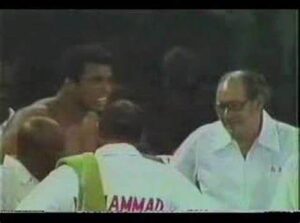
Dr. Ferdie Pacheco, Ali’s personal physician, became increasingly upset and distraught over the beatings Ali took in the twilight of his career, especially in the ‘Thrilla in Manila’ in October 1975, when he retained his title in his third confrontation with Joe Frazier. Over the next two years, he tried several times to discuss the safety in immediate retirement with Ali, who had come to love not being champion and he would not consider retirement. Ironically, after ‘The Rumble in the Jungle’ in October 1974, Ali stated he would probably retire after defeating George Foreman, not wanting to hang around for a couple of dollars. Dr. Ferdie Pacheco was seen on television hugging Ali before this interview in Zaire. Ali did not live up to his own words, perhaps because of the way he went through money, or perhaps because a celebrity never wants to give up their status.
Dr. Pacheco discovered Ali’s speech and reflexes diminished 16 percent after his 15 round titular bout with Earnie Shavers. Following this bout, Dr. Pacheco, according to Wikipedia, performed a post-fight battery of reflex tests on Ali. Ali did not perform at a level requisite for being able to continue to protect himself in the ring in future bouts. Alarmed, his medical protector and confidante Dr. Pacheco recommended Ali retire immediately from boxing. When Ali refused, as he loved fame, limelight, and money, Pacheco broke camp.
Dr. Pacheco decided at the time, from both a medical and ethical perspective, he could not continue as Ali’s primary physician, and left the fighter’s camp permanently. Pacheco later explained “The New York State Athletic Commission gave me a report which showed Ali’s kidneys were falling apart. I wrote to Angelo Dundee (Ali’s trainer). his (Ali’s) wife and Ali himself. I got no response (my concerns were ignored). I decided enough was enough.” Ali fought four more matches, losing three, after Pacheco left his team, before finally retiring after losing to Trevor Berbick in ‘The Drama in the Bahamas’ on December 11, 1981.
Dr. Pacheco wrote in his book ‘Muhammad Ali: A View from the Corner’ in 1992, “When Ali wouldn’t quit the exciting world of boxing, I did. If a national treasure like Ali could not be saved, at least I didn’t have to be part of his undoing (the damage to come).”
Pacheco and Ali remained friends. The two reunited in person for the final time in 2002, when Ali, suffering the acute effects of Parkinson’s syndrome, told his former physician “You was right (when you told me to stop boxing after the Shavers bout).” Ali, whose health and well-being continued to go downhill from there, died a shell of his former self in June 2016 at age 74. Dr. Pacheco died November 16, 2017 at age 89, living long enough to see the cumulative effects of Ali’s not heeding his advice come true, and Ali passing away.
Ali versus Shavers featured Ali and Shavers at their peak prime. The sort of brutal damage Shavers could inflict was later seen later in a WBC title bout with Larry Holmes, when a Shavers right hook not only decked Holmes, but near ripped his head off for a nine count with a powerful overhand right in the seventh round of a world heavyweight title bout in November 1979 at Caesars Palace in Las Vegas. According to Holmes, the bout probably should have been stopped at that point, though Holmes survived to later stop Shavers.
In Ali versus Shavers, Earnie Shavers landed 266 punches to Ali’s 208, and landed 209 power shots to Ali’s 128. Shavers outlanded Ali in eight of the 15 rounds, yet Ali still won by scores of 9-6, 9-6 and 9-5. In the fourth round, Shavers out threw Ali 63 to 26, and outlanded him 22 to one, yet one judge gave the round to Ali. In the ninth round, Shavers outlanded Ali 13 to four, yet all three judges gave the round to Ali. NBC was posting the round by round scorecards on an electronic sign, which trainer Angelo Dundee used to his advantage, knowing after round 12 Shavers needed a knockout to win on the scorecards.
Sparring contributes to repeated head trauma, headgear or not. Larry Holmes blames Earnie Shavers for Ali’s subsequent damage. “I blame Earnie Shavers, I should not, but I do. Ali was okay (neurologically and functionally) before he fought Shavers. When Shavers started hitting him in the head like that, he (Ali) wasn’t the same walking around after that (bout). I’ve watched it (Ali versus Shavers at home) and studied it (the bout). He (Shavers) beat the hell out of him (and Ali was never the same fighter or person after that).”
Fact: a diagnosis of CTE was never made in Ali’s case. Now perhaps he showed symptoms of it, and his family and doctors hid it. That is possible, but it is important at the start to say Ali was never diagnosed with CTE. Ali had Parkinson’s, which his family said was caused or triggered by pesticide exposure in childhood. We will never know exactly for sure what caused it. Science is not sure what causes Parkinson’s, though studies clearly show a connection between blows to the head causing trauma and worsening symptoms.
Parkinson’s disease is a neurodegenerative disorder in which cells in a portion of the brain lose coordination, and tremble. It is the second-most-common neurodegenerative disease, after Alzheimer’s, afflicting approximately 1% of the population older than 60 in developed countries.
Though Ali’s family claims his Parkinson’s was due to the exposure to pesticides during his childhood, the truth is we may never know what causes Parkinson’s completely of the vast majority diagnosed. Ali was unable to pass a physical against Holmes in his second to last fight in Las Vegas with clear symptoms of neurological disease. Ali was also unable to pass a physical for his last fight against Trevor Berbick in The Bahamas. In both cases, another physician was found to sign off. The physicians who signed off on Ali had to declare him physically fit. This did not mean the physicians recommended Ali fight again, and might have recommended against Ali fighting again. It just meant whatever physicians signed off in Ali’s favor were not stopping the intended bout agreed to, contingent on the physical.
Dr. Pacheco lived the rest of his life as a sports commentator for over 40 years in remorse, unable to save Ali from himself. From 1962 to 1977, he had lived as the most vital member of Cassius Clay, later Muhammad Ali’s team. Over time, Ali’s body deteriorated rapidly, his vital organs were failing, and as a result of increasing neurological damage, his speech slurred more and more, and his physical movements slowed. A 1976 ridiculous exhibition with wrestler Rocky Inoki caused Ali’s bruised legs to incur serious permanent ligament damage, a cross sport pointlessly sold exhibition in which Ali rarely landed a punch. It all added up. Dr. Pacheco knew his client Ali from beginning to the bitter end.
Dr. Pacheco did not see Ali over the last 14 years of his life. Perhaps he could have returned to care more, perhaps he did not want to see Ali in total decline, his brilliance reduced to a shadow of his vocal brilliant self. That’s understandable given Dr. Pacheco’s court position as personal physician to ‘The Greatest’. He knew when to walk away when ‘The Greatest’ was not so great anymore, which Ali did not because he did not see it. Before Ali fought Berbick, in the prefight press conference, Ali’s speech was blatantly slurred, yet Ali was still mumbling about regaining the world heavyweight title for the third time. At that point in his life, to attach an ego to such an impossible dream, in reflection, looks like gibberish today.
Ali might have been exposed to pesticides as a child. So far as that excuse from his family as the cause of Ali’s Parkinson’s syndrome, the rest of the world including Dr. Ferdie Pacheco didn’t buy it. Few people are smart enough in professional boxing to get out while they are ahead like Marvelous Marvin Hagler or Rocky Marciano, who actually trained for a comeback but quit when he realized he could not regain his previous championship form.
Earnie Shavers inflicted some the most brutal, vicious damage ever recorded by a heavyweight contender on a defending world heavyweight champion in a world title bout. Dr. Pacheco, ringside and in Ali’s training camp for 15 years, had seen enough. A doctor’s goal is to protect his patients. Money was not the motive. Dr. Pacheco sought to protect Ali from himself. As a former member of the Elvis Presley bodyguard entourage, Dave Hebler, once noted, “Protect a man? How do you protect a man from himself?” As Dr. Pacheco learned, you cannot. It is good Muhammad Ali’s Deer Lake training camp in Pennsylvania has been restored. Its symbolic value remains open to interpretation, as to whether the bouts Ali trained for there after the Earnie Shavers bout without Dr. Pacheco in his entourage were a good or bad thing. Certainly in losing three of his last four bouts, Ali proved Dr. Pacheco correct. Dr. Pacheco’s story and Muhammad Ali’s legend remain boxing history. My final thought is if Ali fought Larry Holmes, Mike Weaver or Trevor Berbick in November or December of 1978, Ali might have done better, though I do not believe Ali would have won. Maybe he could have drawn. Ali could have gone the distance.


 English