







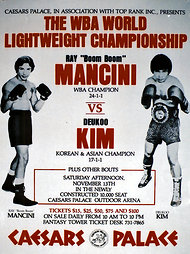
Ray Mancini versus Deuk-Koo Kim 1982 Title Bout: A Historical Look Back
By Robert Brizel, Head Real Combat Media Boxing Correspondent
Ray ‘Boom-Boom’ Mancini of Youngstown, Ohio, had three World Lightweight title bouts which ended in the fourteenth round back in the day: his loss to Alexis Arguello for the WBC title in 1981; his victory over southpaw Deuk-Koo Kim of South Korea to retain the WBA title in 1982; and his loss of the WBA title to Livingston Bramble in their first encounter in 1984. Mancini won four bouts, then lost four bouts as his career ended in 1992 at age 31. He had not won a bout in eight years when he lost to Greg Haugen in April 1992.
Part of Ray Mancini died in the ring with Deuk-Koo Kim when he knocked him out. Kim slipped into a coma, and died four days later of his ring injuries. Kim’s mother and referee Richard Greene both subsequently took their own lives. Mancini had lost the boom in his boom, and like Emile Griffith, Sugar Ray Robinson and others, was never the same fighter after the Kim tragedy. CBS Television boxing with Tim Ryan and Gil Clancy was never quite the same either.
As a result of Kim’s death in the WBA World Lightweight title bout at Caesars Palace in Las Vegas, Nevada, the World Boxing Council ordered all world title bouts be reduced from 15 to 12 rounds. The WBA and the IBF followed suit in 1987. The Nevada State Athletic Commission also moved to increase the number of ring ropes from three to four to prevent fighters from falling through the ropes. While tragedy has never been altogether prevented in boxing, it was reduced considerably. In 1982, most boxing commissions required only a fighter’s blood pressure be taken. Today, most jurisdictions required medical tests which are considerably more comprehensive, to protest the life of the fighter.
The critical element is after being involved in such a tragedy, the winning fighter subconsciously and instinctively does not want to hurt the other guy, so as to avoid a repeat tragedy. This sort of personality change is a natural outcome. Mancini was able to accept kim’s death as an accident. For the rest of his life, Kim’s death has still haunted him.
Sugar Ray Robinson once testified “I don’t want to harm the other guy, I just want to knock him out.” A critical analysis of the Deuk-Koo Kim versus Ray Mancini footage reveals referee Richard Greene should have stopped the fight earlier in the fourteenth round when Kim was no longer able to defend himself and was just trying to hold, hang on and survive. The straight right to the chin from Mancini which finished game title challenger Deuk-Koo Kim was not an incredible power punch by any means, just an accurate coup-de-grace which simply sent the exhausted Kim down on his back. Kim actually beat the count.
The courage Deuk-Koo Kim showed on that day was matched only by what Kim wrote on his dressing room mirror, which was ‘Kill or Be Killed’. In the end, Kim write his own epitaph, a chilling prophecy of what every boxer must face, his own mortality and that of his opponent. It is a stark reality great boxers accept with class and dignity, a reality only they can fully understand. In 2002, the movie ‘Champion’ on Deuk-Koo Kim’s life was released, directed by Kwak Kyung Taek. In 2008, South Korea’s former World Flyweight champion Yo-Sam Choi died from injuries received after winning a December 2007 12 round bout. Deuk-Koo Kim’s fiancée and son met Ray Mancini in 2011 as part of the 2011 film documentary ‘The Good Son’ on the life of Mancini.


 English